Youngjin Yeom

© Copyright 2026 Youngjin Yeom. All rights reserved.

Made with Next.js and Tailwind CSS

Navigation

  • Home
  • Research
  • Blog
  • Contact

Connect with me

Observing Asteroids

Asteroid follow-up imaging with the 0.7 m CDK700 telescope

Department of Physics, Pusan National UniversityMiryang Arirang Astronomical Observatory (MAAO, MPC P71)2022.08 - 2022.11
Scroll Down
Updated: May 12, 2026
Tags:astronomyasteroidstelescope

Project Overview

This was an undergraduate observing project carried out with PNU Skyship, an astronomy club at Pusan National University. We used the 0.7 m PlaneWave CDK700 telescope at the Miryang Arirang Astronomical Observatory (MAAO) — IAU MPC observatory code P71 — to capture follow-up images of already numbered asteroids.

My role was the club's observation lead: I helped plan observation runs and operate the telescope during the sessions. Heavy data analysis such as orbit determination or N-body propagation was not part of this project. The point of the project was the hands-on experience of pointing a 0.7 m telescope at a known asteroid and actually catching it on the CCD, at an undergraduate level.

Observation Equipment: CDK700 @ MAAO (P71)

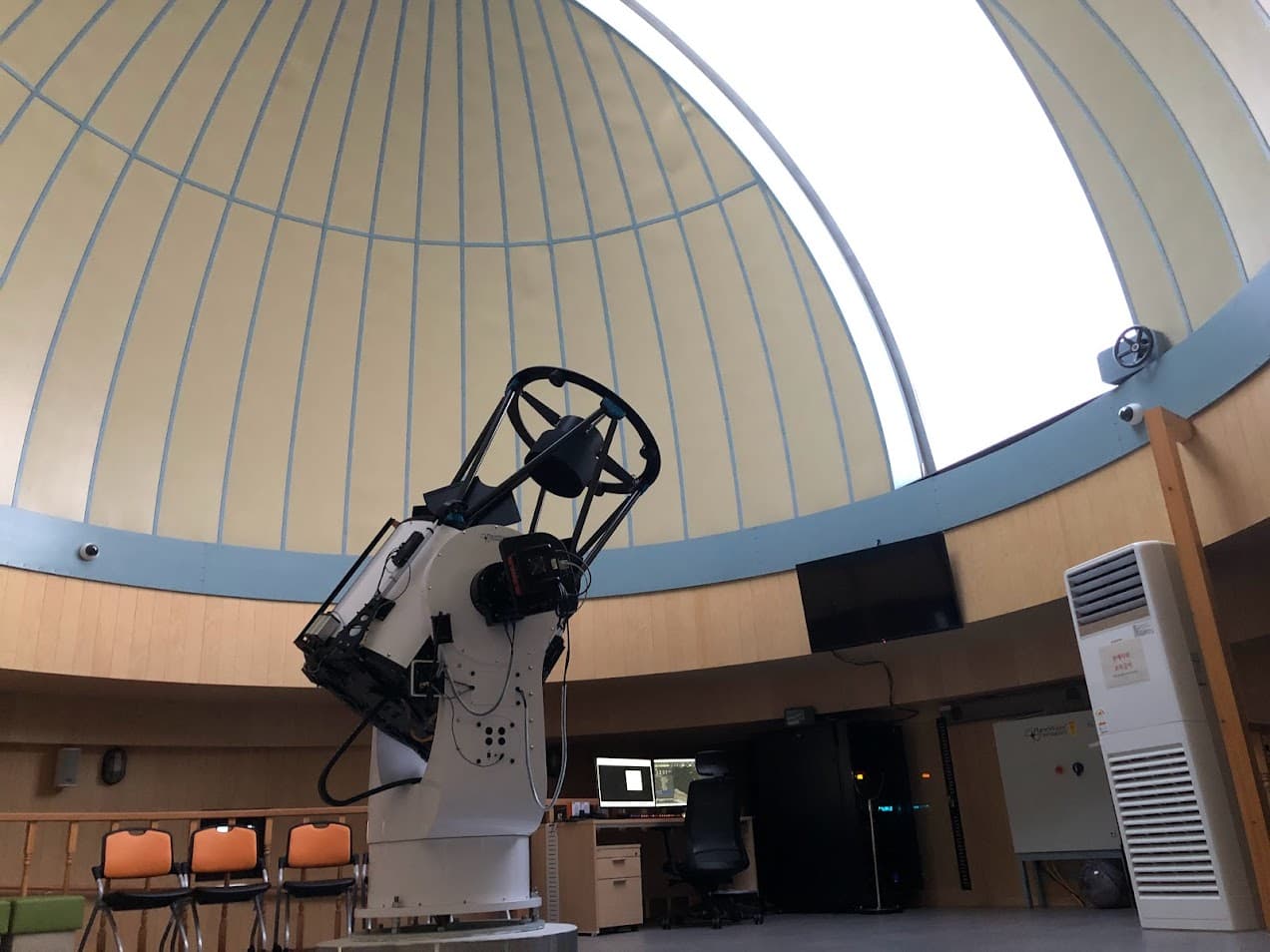
CDK700 Telescope

The PlaneWave Instruments CDK700 is a research-grade telescope with a 700 mm Corrected Dall-Kirkham primary mirror. At MAAO it is paired with an SBIG STX-16803 CCD and operated as a robotic 0.7 m system, as described in Lim et al. (PASP 2024).

Optics:Corrected Dall-Kirkham (CDK)
Aperture / f-ratio:700 mm / f/6.5
Mount:PlaneWave Direct-Drive Alt-Azimuth
Detector:SBIG STX-16803 CCD
Site:Miryang Arirang Astronomical Observatory (MPC P71)

What I Did

Observation planning

Looked up the published ephemerides of target asteroids, picked observable windows, and coordinated the schedule with MAAO.

Telescope observation

Operated the CDK700 to track the target field and acquired time-series images. Identified the target asteroid by the point that moved relative to the background stars across frames.

Tools Used

  • Telescope control: PlaneWave Interface (PWI)
  • Image inspection: FITS viewers such as SAOImage DS9
  • Ephemeris references: JPL Horizons, IAU Minor Planet Center

What I Took Away

  • Hands-on familiarity with running a 0.7 m research telescope (slew, track, expose) at an undergraduate level.
  • Learned how to use ephemerides to plan observing windows and how to spot a moving Solar System body in a sequence of images.
  • This was a club-level observation experience rather than a full astrometry / orbit-determination study.

References

  • The Robotic MAAO 0.7m Telescope System: Performance and Standard Photometric System

    Lim, G. et al.

    Publications of the Astronomical Society of the Pacific 136, 055001 (2024), arXiv:2404.15884

    https://arxiv.org/abs/2404.15884

  • IAU Minor Planet Center — Observatory Codes

    IAU Minor Planet Center

    minorplanetcenter.net

    https://www.minorplanetcenter.net/iau/lists/ObsCodes.html

  • JPL Horizons System

    NASA / JPL Solar System Dynamics

    ssd.jpl.nasa.gov/horizons

    https://ssd.jpl.nasa.gov/horizons/