Asteroid Orbit Analysis
Orbit Determination and Simulation using the CDK700 Telescope
Department of Physics, Pusan National UniversityMiryang Arirang Astronomical Observatory2022.08 - 2022.11
Scroll Down
Updated:
Tags:astronomyasteroidstelescopesimulation
Research Context
The discovery and tracking of Near-Earth Objects (NEOs) are crucial in modern astronomy for planetary defense and understanding the formation of the solar system.
In particular, asteroids less than 1km in diameter require continuous monitoring due to their sheer abundance and frequent orbital perturbations.
This project aims to conduct follow-up observations of target asteroids using the 0.7m CDK700 telescope at Miryang Arirang Astronomical Observatory (MAAO), and calculate their Orbital Elements based on the acquired data to simulate future positions.
I led this project as the head of observation at the PNU Skyship club, and after submitting and verifying actual observation data to the Minor Planet Center (MPC), our newly established observatory was granted an observation code.
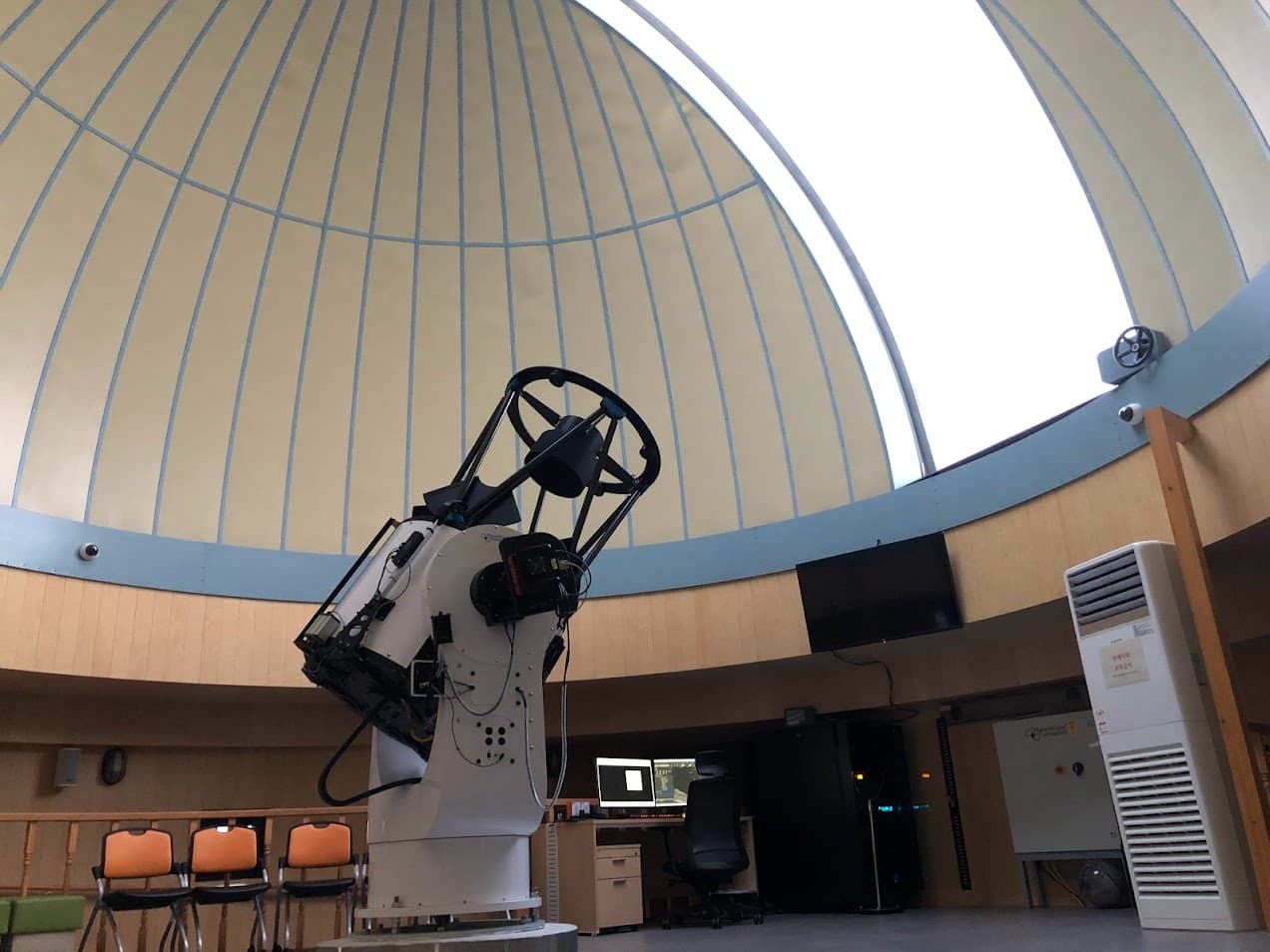
Observation Equipment: CDK700
The CDK700 telescope by PlaneWave Instruments is a research-grade instrument with a 0.7m large primary mirror and precise pointing capabilities. Coupled with a high-sensitivity CCD camera, it can precisely track faint asteroids down to 18th magnitude.
Optics:Corrected Dall-Kirkham (CDK)
Aperture/Focus:700mm / 4540mm (f/6.5)
Mount:PlaneWave Direct-Drive Alt-Azimuth
Location:Miryang Arirang Astronomical Observatory (MAAO)
Methodology
Observation & Data Acquisition
Utilized the CDK700 telescope to capture time-series FITS images of fields containing target asteroids according to an observation schedule.
Astrometry
Extracted precise Right Ascension (RA) and Declination (Dec) coordinates of the asteroids from captured FITS images through Plate Solving, and comparatively analyzed them against the Minor Planet Center (MPC) database.
Orbit Determination & Simulation
Calculated the 6 Keplerian Orbital Elements backward from the observed coordinate data, and performed numerical integration simulations to predict future trajectories using Python and the Rebound library.
Tools & Technologies
- Telescope Control: PlaneWave Interface 4 (PWI4)
- Image Processing: SAOImage DS9, MaxIm DL
- Data Analysis: Python (Astropy, NumPy, Pandas)
- Simulation: Rebound (N-body integrator), Stellarium
- Astrometry Software: Astrometrica
Project Details & Outcomes
- Successfully tracked and imaged faint asteroids of approximately 18th magnitude using a 0.7m telescope.
- Extracted precision astrometry data and completed cross-validation with the Minor Planet Center (MPC) database.
- Calculated orbital elements from observed data and confirmed accuracy through N-body simulations.
- Gained practical experience in operating research-grade telescopes and astronomical data processing.
References
The Robotic MAAO 0.7m Telescope System: Performance and Standard Photometric System
Lim, G. et al.
arXiv:2404.15884 [astro-ph.IM]
Asteroid Photometry from Small Telescopes
Warner, B. D.
Minor Planet Observer, Palmer Divide Observatory
Near-Earth Objects: Finding Them Before They Find Us
Yeomans, D. K.
Princeton University Press
https://press.princeton.edu/books/hardcover/9780691149292/near-earth-objects