ALICE ITS3 WP4 Research
Bent Silicon Detector Characterization for the ALICE Inner Tracking System Upgrade
Pusan National University HIPEx LabCERN ALICE Collaboration2023.03 - 2024.01
Scroll Down
Updated:
Tags:particle-physicsCERNdetectorsilicon
Research Background and Necessity
Why do we need thin, bent sensors?
The ALICE experiment investigates the properties of the 'Quark-Gluon Plasma (QGP),' the state of the universe right after the Big Bang. The key to this research is observing heavy particles like Charm and Beauty quarks that punch through the interior of the QGP.
Just like throwing a heavy bowling ball into a foggy room to determine the fog's density from its trail, these heavy quarks act as that allow us to figure out the properties of the QGP.
However, these particles have extremely short lifetimes and decay in a fraction of a moment. Therefore, to capture their minute positions right before they decay, a highly precise detector must be placed as close as possible to the collision point.
In the ALICE experiment at the LHC, the Inner Tracking System (ITS) takes on this role. The next-generation model, ITS3, introduces a revolutionary idea: installing paper-thin silicon sensors by rolling them into a cylindrical shape.
A flat, single piece of silicon is very thin and weak, making it difficult to maintain its shape on its own under the influence of gravity without additional structures, but when rolled into an arch shape, it becomes sturdy. Utilizing this allows it to maintain its shape without the need for separate support structures or cooling pipes.
Thanks to this, the , which is the obstacle blocking the particles, can be drastically lowered (to about 0.05% X₀ per layer).
As a result, the effect that occurs in low-momentum particles is minimized, and interference experienced by the particles is reduced, allowing for more accurate trajectory measurements.
ITS3 Sensor and FPC Operation
How to connect and operate thin, flexible sensors?
Once thin silicon sensors that bend to gain geometric stiffness were devised, the next challenge was how to supply power and retrieve data from them. To solve this, the Flexible Printed Circuit (FPC) serves as the backbone for establishing physical and electrical connections.
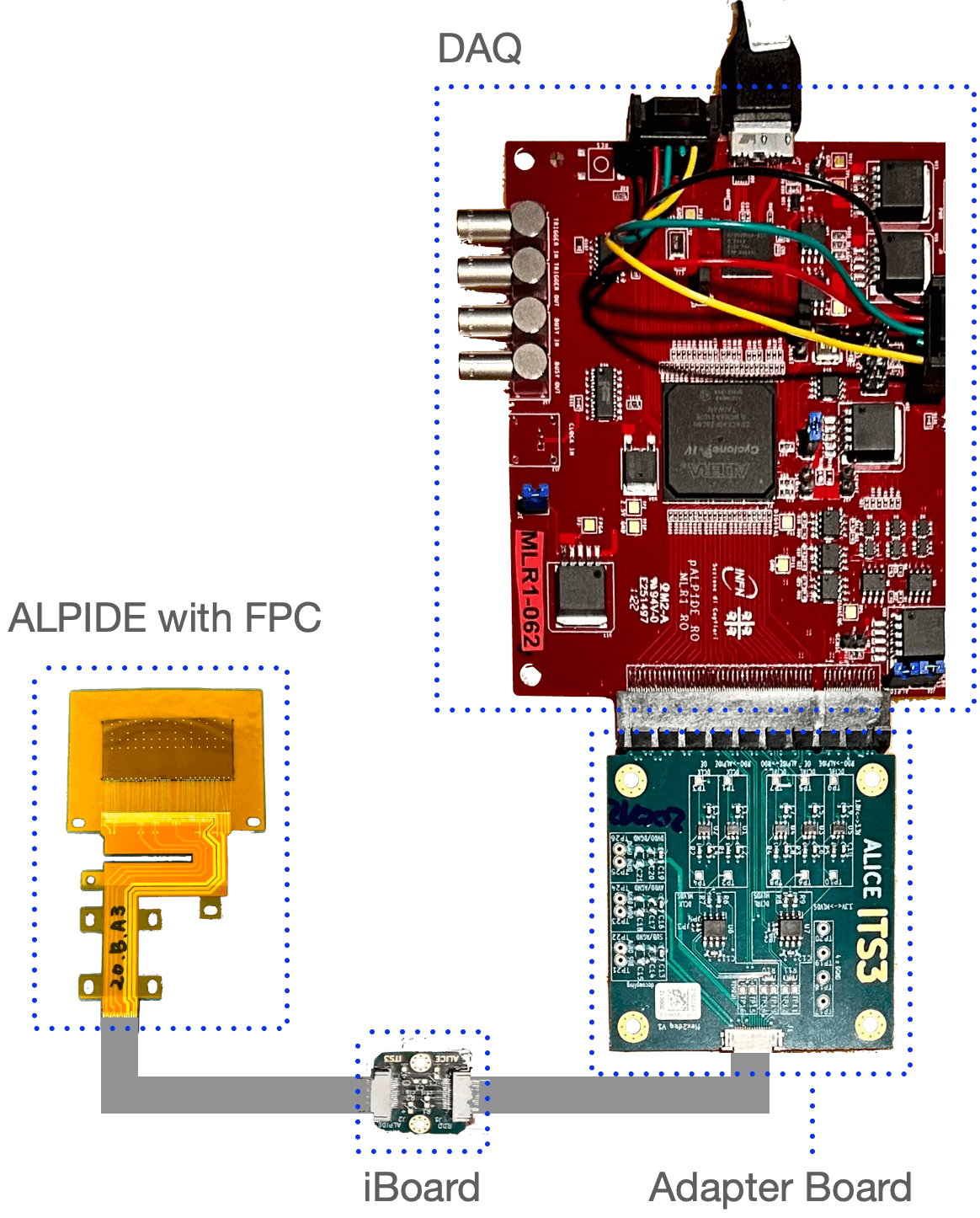
The photo on the left shows the actual setup where the ALPIDE sensor is bonded to the FPC (Flexible Printed Circuit).
This FPC is made of thin and flexible material, which stably maintains electrical connections when realizing the 'bent sensor,' the core goal of ITS3. Additionally, it plays a pivotal role in supplying power and transmitting high-speed data by connecting the sensor to the FPGA-based Interface Board.
Research Objectives and Hardware Engineering
Precision hardware design for validating bent sensor performance
As a member of Pusan National University's Heavy Ion Physics Experiment Lab (HIPEx), I participated in the ALICE Collaboration's ITS3 WP4 (Mechanics & Engineering) research. The main research task was to verify whether the 50 and 100μm thick silicon sensors break or suffer electrical pixel response degradation when rolled roundly (radii 18mm, 24mm, 30mm) as in the actual design.
To achieve this, the first problem to solve was, "How can we precisely bend and secure a paper-thin silicon sensor to the desired radius without breaking it?" I built the test environment by designing 'PNU Guide & Frame', a custom mechanical jig assembly in 3D CAD, and 3D printing it. This allowed us to bend the sensor-FPC assembly safely.
 (Placeholder: 3D design rendering image of the PNU Guide & Frame will be added here)
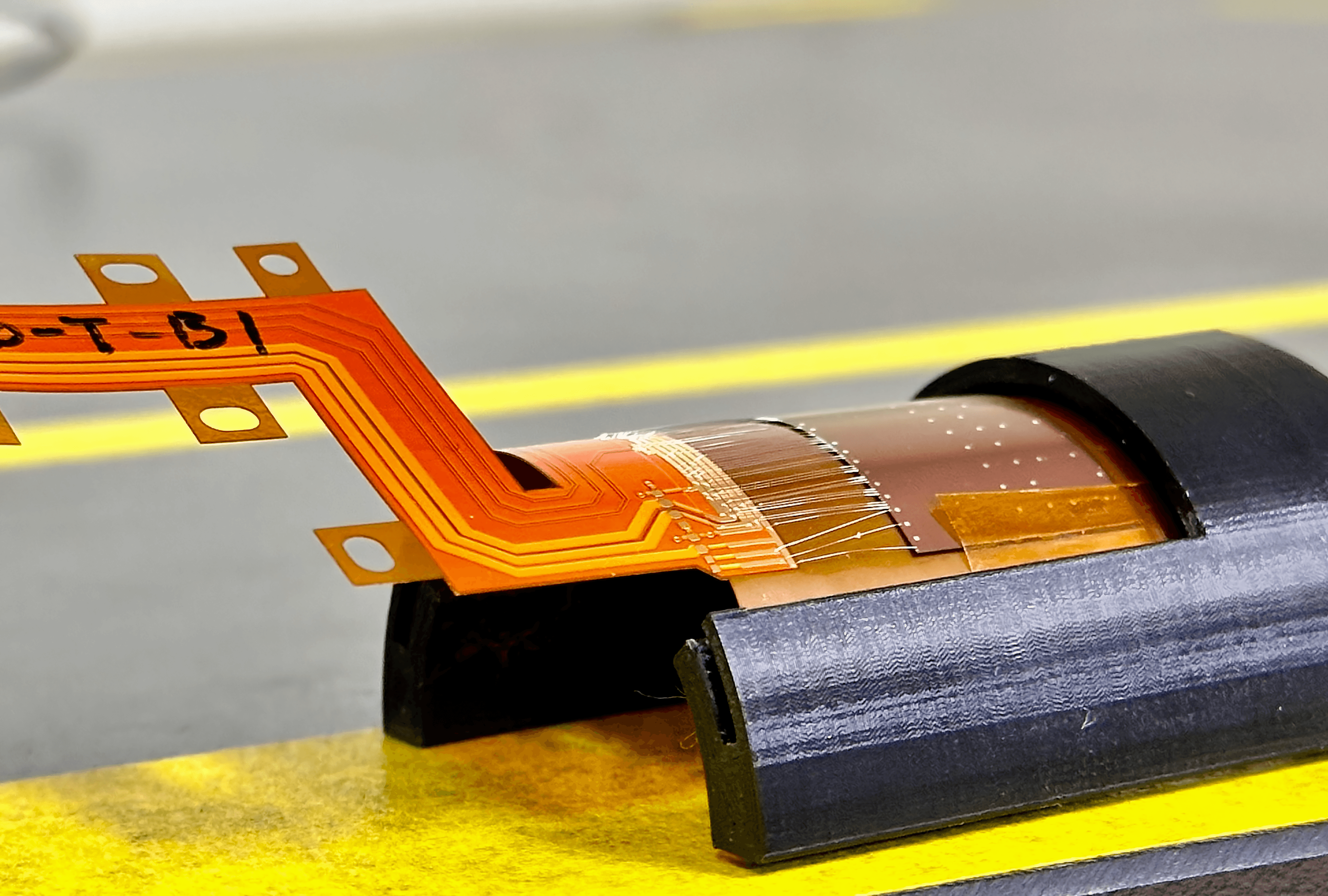
ALPIDE Sensor Prototype Bent to an 18mm Radius of Curvature
This shows a 50μm thick ALPIDE sensor rolled up and secured using the custom-designed PNU Guide & Frame. In this state, the threshold and noise levels of the sensor were measured and compared to the flat state.
Photo Date:November 2023
Core Technology:Bent Silicon MAPS (Monolithic Active Pixel Sensor)
Research Topic:Performance validation under bending stress
Test Environment:PNU HIPEx Lab (Dark Room)
Research and Measurement Methodology
Repeatable Environment Setup
Established a stable test setup that allowed for the repeated process of accurately bending the ALPIDE chip to the desired curvatures (18, 24, 30mm) and flattening it again without causing physical damage.
Electrical Characteristic Scan
Measured and mapped the signal detection baseline (Threshold) and Noise distributions of each pixel before and after bending. The core goal was to discern if stress triggers an increase in Fake Hits.
Data Pipeline Analysis
Statistically processed and visualized over 500,000 pixel datasets using C++ and the ROOT framework to track the impact of the bending stress, especially near the matrix edges.
Troubleshooting and Insights
Identifying the cause of sensor measurement anomalies in IR environments
During the research, while conducting a sensor beamtime test at the Gyeongju Proton Accelerator, a problem arose where continuous, inexplicable anomalies (errors) were detected in the sensor's measurement values.
While exploring various possibilities to find the cause, I focused on the intrinsic physical properties of the silicon. Since the bandgap of silicon is about 1.12 eV, it can absorb near-infrared light (Near IR, wavelength ~1100 nm) and generate electron-hole pairs. Therefore, I hypothesized that the infrared rays emitted by the IR CCTV camera for night vision installed inside the accelerator irradiation room were hitting the thin sensor, causing fake hits and Threshold Scan errors.
To prove this, I returned to the laboratory and conducted a reproduction experiment by intentionally irradiating infrared rays onto the ALPIDE sensor inside a fully controlled dark room. As a result, I confirmed the exact same Threshold Scan anomalies that we had experienced at the accelerator. This process went beyond simply following a given measurement manual; it was an experience that provided deep insight into identifying and independently proving the cause of seemingly unexplainable errors in the field based on physical knowledge.
Ultimately, no significant performance degradation due to bending was observed in the sensor itself, regardless of whether it was flat or curved, but we gathered the practical conclusion that controlling ambient light conditions (especially IR) is highly critical. The bending research itself was eventually halted due to mandatory military service, so a final conclusion agreed upon by the joint research group was not reached.
Applied Technologies and Tools
- Detector Physics: Silicon Pixel Detectors (MAPS Technology)
- Data Analysis: C++, ROOT Framework
- Hardware: 3D CAD Design, FPC handling, ALPIDE Readout System (FPGA DAQ)
- Measurement Techniques: Threshold Scan, Noise Occupancy Test, DAC Tuning
- Development Environment: Linux (CentOS)
Summary of Research Activities
- Measured sensor noise and signal baseline characteristics while toggling between flat and curved (18mm radius) states
- Designed and 3D-printed custom mechanical jigs (PNU Guide & Frame) for safe sensor bending
- Hypothesized and experimentally proved the severe impact of IR irradiation on silicon sensor measurements
- Contributed to C++ ROOT data analysis scripts and participated in ALICE ITS3 group meetings
Research Participation Information
- Affiliation: Heavy Ion Physics Experiment Lab (HIPEx), Pusan National University
- Role: Undergraduate Researcher (ITS3 WP4 Mechanical design and performance validation)
- Period: March 2023 - January 2024
References
ITS3: A Monolithic Active Pixel Sensor for the ALICE Inner Tracking System Upgrade
A. Van Lysebetten et al.
Nuclear Instruments and Methods in Physics Research Section A, Volume 1060, 166640
Characterization of bent ALPIDE sensors for the ALICE ITS3 upgrade
ALICE Collaboration
Journal of Instrumentation, Volume 18, P01001
The ITS3 detector and physics reach of the LS3 ALICE Upgrade
ALICE Collaboration
arXiv:2409.01866 [physics.ins-det]